| |
| |
Larysa
Petrivna Kosach-Kvitka (February 25 [O.S.
February 13] 1871 – August 1 [O.S. July 19] 1913) better
known under her literary pseudonym Lesya Ukrainka, was one
of Ukraine's best-known poets and writers and the foremost
woman writer in Ukrainian literature. She also was a political,
civil, and feminist activist.
Wikipedia
Lesya
Ukrainka, pseudonym of Larisa Petrovna Kosach-Kvitka
(born Feb. 13 [Feb. 25, New Style], 1871, Novograd-Volynsky,
Ukraine, Russian Empire [now Novohrad-Volynskyy, Ukraine]—died
July 19 [Aug. 1], 1913, Surami, Georgia, Russian Empire [now
in Georgia]), poet, dramatist, short-story writer, essayist,
and critic who was the foremost woman writer in Ukrainian
literature and a leading figure in its modernist movement.
The
daughter of intellectuals, Ukrainka was stricken with tuberculosis
in 1881 and traveled widely thereafter in search of a cure.
Her early lyrical verse, influenced by Taras Shevchenko, dealt
with the poet’s loneliness and social alienation and
was informed by a love of freedom, especially national freedom.
The collections Na krylakh pisen (1893; “On the Wings
of Songs”), Dumy i mriyi (1899; “Thoughts and
Dreams”), and Vidhuky (1902; “Echoes”) established
her as the leading young Ukrainian poet of the day.
She
was active in the Ukrainian struggle against tsarism and joined
Ukrainian Marxist organizations, translating the Communist
Manifesto into Ukrainian in 1902. In 1907 she was arrested
and, following her release, was kept under observation by
the tsarist police. She married the court official Klyment
Kvitka in 1907.
Ukrainka
concentrated on poetic dramas from about 1906 on. Her plays
were inspired by various historical milieus—e.g., the
Old Testament in Oderzhyma (1901; “A Woman Possessed”)
and Vavylonsky polon (1908; The Babylonian Captivity), the
world of ancient Greece and Rome, the early Christian era
in U katakombakh (1906; In the Catacombs) and Na poli krovy
(1911; “On the Field of Blood”), and the medieval
period. Folk songs and fairy tales provide the framework for
Lisova pisnya (1912; Forest Song), in which Ukrainka reflects
on the timeless tension between exalted ideals and sordid
reality. Her historical drama Boyarynya (1914; The Noblewoman)
is a psychological tragedy centring on a Ukrainian family
in the 17th century.
Ukrainka
also wrote short stories and critical essays and did masterful
translations of works by Homer, William Shakespeare, Lord
Byron, Victor Hugo, and Ivan Turgenev.
Written by: The Editors of Encyclopædia
Britannica |
|
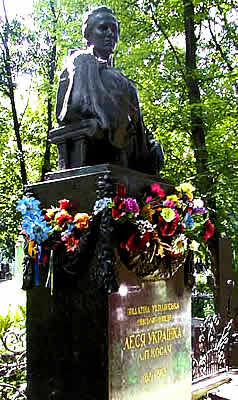 Lesya
Ukrainka's burial location
Lesya
Ukrainka's burial location
and monument
at Baikove Cemetery in Kiev |
|
|
| In
1893 at age eighteen Lesya Ukrainka published her first book
of poems in Ukrainian, On the Wings of Songs.
She was not allowed to publish it in the Russian Empire, and
instead had it published in Western Ukraine which was then under
the Austro-Hungarian Empire. Risking her life, she had the book
smuggled into Kyiv. |
|
|
|
| Bio
|
| |
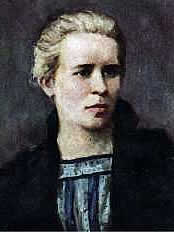
Lesya
Ukrainka
|
Lesya
Ukrainka
(1871-1913)
Biographical Sketch
Lesya
Ukrainka is the literary pseudonym of Larysa Kosach - Kvitka,
who was born in 1871 to Olha Drahomanova-Kosach (literary
pseudonym: Olena Pchilka), a writer and publisher in Eastern
Ukraine, and Petro Kosach, a senior civil servant. An intelligent,
well-educated man with non-Ukrainian roots, he was devoted
to the advancement of Ukrainian culture and financially
supported Ukrainian publishing ventures.
In
the Kosach home the mother played the dominant role; only
the Ukrainian language was used and, to avoid the schools,
in which Russian was the language of instruction, the children
had tutors with whom they studied Ukrainian history, literature,
and culture. Emphasis was also placed on learning foreign
languages and reading world literature in the original.
In addition to her native Ukrainian, Larysa learned Russian,
Polish, Bulgarian, Greek, Latin, French, Italian, German,
and English. |
A
precocious child, who was privileged to live in a highly cultivated
home, Larysa began writing poetry at the age of nine, and when she
was thirteen saw her first poem published in a journal in L'viv
under the name of Lesya Ukrainka, a literary pseudonym suggested
by her mother. As a young girl, Larysa also showed signs of being
a gifted pianist, but her musical studies came to an abrupt end
when, at the age of twelve, she fell ill with tuberculosis of the
bone, a painful and debilitating disease that she had to fight all
her life.
Finding
herself physically disabled, Lesya turned her attention to literature
- reading widely, writing poetry, and translating. She shared these
literary activities with her brother Mykhaylo (literary pseudonym:
Mykhaylo Obachny), her closest friend until his death in 1903. When
Larysa was seventeen, she and her brother organized a literary circle
called Pleyada (The Pleiades) which was devoted to promoting the
development of Ukrainian literature and translating classics from
world literature into Ukrainian.
As
a teenager, Larysa's intellectual development was further stimulated
by her maternal uncle, Mykhaylo Drahomanov, the noted scholar, historian
and publicist. He encouraged her to collect folk songs and folkloric
materials, to study history, and to peruse the Bible for its inspired
poetry and eternal themes. She was also influenced by her family's
close association with leading cultural figures, such as Mykola
Lysenko, a renowned composer, and Mykhaylo Starytsky, a well-known
dramatist and poet.
Lesya
published her first collection of lyrical poetry, Na krylakh pisen'
(On Wings of Songs), in 1893, a year after her translations of Heine's
poetry, Knyha pisen' (The Book of Songs) appeared. In the Russian
Empire, Ukrainian publications were banned; therefore, both books
were published in Western Ukraine and smuggled into Kyiv.
From
the time that Lesya was a teenager, she often had to go abroad for
surgery and various treatment regimens, and was advised to live
in countries with a dry climate. Residing for extended periods of
time in Germany, Austria, Italy, Bulgaria, Crimea, The Caucasus,
and Egypt, she became familiar with other peoples and cultures,
and incorporated her observations and impressions into her writings.
An inveterate letter writer, she engaged in an extensive correspondence
with the Western Ukrainian author Olha Kobylianska that led to an
exchange of sketches both entitled "The Blind Man." (See
Volume III of this series.)
In
addition to her lyrical poetry, Ukrainka wrote epic poems, prose
dramas, prose, several articles of literary criticism, and a number
of sociopolitical essays. It was her dramatic poems, however, written
in the form of pithy, philosophical dialogues, that were to be her
greatest legacy to Ukrainian literature. Only one of Ukrainka's
dramas, Boyarynya (The Boyar's Wife) refers directly to Ukrainian
history, and another, an idealistic, symbolic play, Lisova pisnya
(Song of the Forest), uses mythological beings from Ukrainian folklore.
Her other dramatic poems issue from world history and the Bible.
With their sophisticated psychological treatment of the themes of
national freedom, dignity, and personal integrity, they are a clarion
call to people the world over to throw off the yoke of oppression.
In
1901, Lesya suffered a great personal loss - the death of her soul
mate, Serhiy Merzhynsky. She wrote the entire dramatic poem Oderzhyma
(The Possessed) in one night at his deathbed. A few years later,
in 1907, she married a good friend of the family, Klyment Kvitka,
an ethnographer and musicologist. It was he who transcribed and
published the many Ukrainian folk songs that she had learned as
a young girl in her native province of Volyn.
Despite
many prolonged periods in her life during which she was too ill
to write, upon her death in 1913, at the relatively young age of
forty-two, Ukrainka left behind a rich and diversified literary
legacy. While it is the deep philosophical thought and the perfection
of her poetic form that have assured her a place among the luminaries
of world literature, her prose works, which she continued writing
throughout her literary career, provide a fascinating insight into
the inner life of this gifted, multifaceted writer, and reveal her
perceptions of the multi - layered society in which she lived.
©1998
Language Lanterns Publications |
|
|
|
|
Lesya
Ukrainka
(Laryssa Kossatch)
Contra
spem spero
Thoughts,
away, you heavy clouds of autumn!
For now springtime comes, agleam with gold!
Shall thus in grief and wailing for ill fortune
All the tale of my young years be told?
No,
I want to smile through tears and weeping,
Sing my songs where evil holds its sway,
Hopeless, a steadfast hope forever keeping,
I want to live ! You, thoughts of grief, away!
On
poor, sad, fallow land, unused to tilling,
I'll sow blossoms, brilliant in hue,
I'll sow blossoms where the frost lies, chilling,*
I'll pour bitter tears on them as dew.
And
those burning tears shall melt, dissolving
All that mighty crust of ice away,
Maybe blossoms will come up, unfolding
Singing springtime for me, too, some day.
Up
the flinty, steep and craggy mountain
A weighty ponderous boulder I shall raise,
And bearing this dread burden, a resounding
Song I'll sing, a song of joyous praise.
In
the long dark ever-viewless night time
Not one instant shall I close my eyes,
I'll seek ever for the star to guide me,
She that reigns bright mistress of dark skies.
Yes,
I'll smile, indeed, through tears and weeping,
Sing my songs where evil holds its sway,
Hopeless, a steadfast hope forever keeping,
I shall live ! You thoughts of grief-away !
Translated
by Vera Rich
*
Line 11 is ambiguous. If " morozi " is taken to
be the prepositional case not of " moroz, " but
of " morih, " the line should be translated :"
I'll sow blossoms, on the greensward spilling, "
|
|
|
| |
|


